Choosing among China’s best Belt Drive Motor manufacturers requires more than comparing catalogue prices. Buyers should examine production experience, engineering capability, testing procedures, and after-sales support. A motor may look competitive online yet perform poorly under dust, heat, vibration, or irregular loading. The right supplier explains these risks clearly.
In practical sourcing work, reliable manufacturers usually provide detailed datasheets, efficiency ratings, insulation classes, bearing information, and dimensional drawings. They should also discuss pulley alignment, belt tension, starting torque, duty cycles, and noise control. Factory audits can reveal useful details, including winding stations, balancing equipment, test benches, and packaging methods. Ask for recent test records. Check references from comparable industries.
There is no universal “best” manufacturer. Conveyor systems, ventilation units, agricultural equipment, and industrial machinery require different motor designs. Some suppliers excel at standard production, while others handle customized shafts, voltages, braking systems, or mounting options. That difference matters.
Still, supplier evaluation is not always perfect. Online certifications may require independent verification, and sample performance may not represent long-term production quality. Buyers should compare several quotations, inspect samples, confirm warranty terms, and clarify replacement procedures before signing an order. A dependable partner welcomes technical questions and documents its answers. Small details matter. This guide examines leading Chinese manufacturers through a practical, evidence-based lens, helping international buyers make safer and more informed decisions.
Belt drive motors transfer rotational power through a motor pulley, a belt, and a driven pulley. The motor turns the first pulley. The belt carries that motion to the second one. The pulley follows. This simple arrangement can change speed, torque, and shaft direction without complex gearing.
In practical equipment inspections, I have found belt tension is often the deciding factor. A loose belt slips, creates heat, and reduces output. An overly tight belt stresses bearings and shortens service life. Correct alignment matters too. Even a small offset can produce edge wear, vibration, and irritating noise. Different belt profiles suit different loads, temperatures, and operating speeds. Designers should check torque, duty cycle, pulley diameter, and expected maintenance conditions before selecting a motor system.
China’s belt drive motor manufacturers commonly serve conveyors, fans, pumps, agricultural machines, and workshop equipment. Reliable production depends on consistent winding quality, accurate machining, insulation control, and documented testing. Buyers should request efficiency data, rated operating conditions, protection levels, and replacement-belt information. Guarding is essential because exposed rotating parts can cause serious injuries. Maintenance staff should inspect cracks, dust buildup, tension, and unusual vibration during scheduled checks. Some published performance figures look impressive, but field conditions may differ. That is where careful testing remains necessary.
Why Choose Chinese Belt Drive Motor Manufacturers?
Chinese belt drive motor manufacturers offer practical advantages when buyers need scale, customization, and controlled production costs. The International Energy Agency reports that electric motor systems consume more than 40% of global electricity. This makes efficiency testing a purchasing priority, not a minor specification. Experienced Chinese factories often provide motor, pulley, belt, and enclosure options for agricultural equipment, conveyors, pumps, and ventilation systems.
Production depth is another reason to consider China. Suppliers can combine casting, winding, machining, balancing, and final assembly within connected manufacturing networks. This may shorten development cycles and support larger orders. The U.S. Department of Energy notes that motor systems can represent about 70% of industrial electricity use. Therefore, buyers should request efficiency curves, temperature-rise records, vibration data, and load-test results. Test records help. Ask for traceable reports, not attractive promises.
Cost remains important, but the lowest quotation deserves careful review. A cheaper motor may use thinner insulation, weaker bearings, or inconsistent belt alignment. No supplier is perfect. Even established factories can struggle with communication, sample approval, or after-sales response. I would compare factory audits, IEC 60034 compliance, warranty terms, spare-parts availability, and independent inspection results. The World Bank’s logistics research also shows that delivery performance depends on infrastructure and coordination, not manufacturing capacity alone. A thoughtful Chinese supplier can reduce total ownership costs, but only when technical verification comes before price negotiation.
How to Evaluate China’s Leading Belt Drive Motor Suppliers
Evaluating China’s leading belt drive motor suppliers requires more than comparing catalog prices. Begin with operating data: rated torque, speed range, duty cycle, ambient temperature, and expected load variation. Ask for test records matching your application, not generic laboratory claims. An experienced supplier should explain pulley alignment, belt tension, heat dissipation, and bearing life clearly. Request drawings, tolerance tables, wiring diagrams, and traceable quality procedures. Good answers are specific.
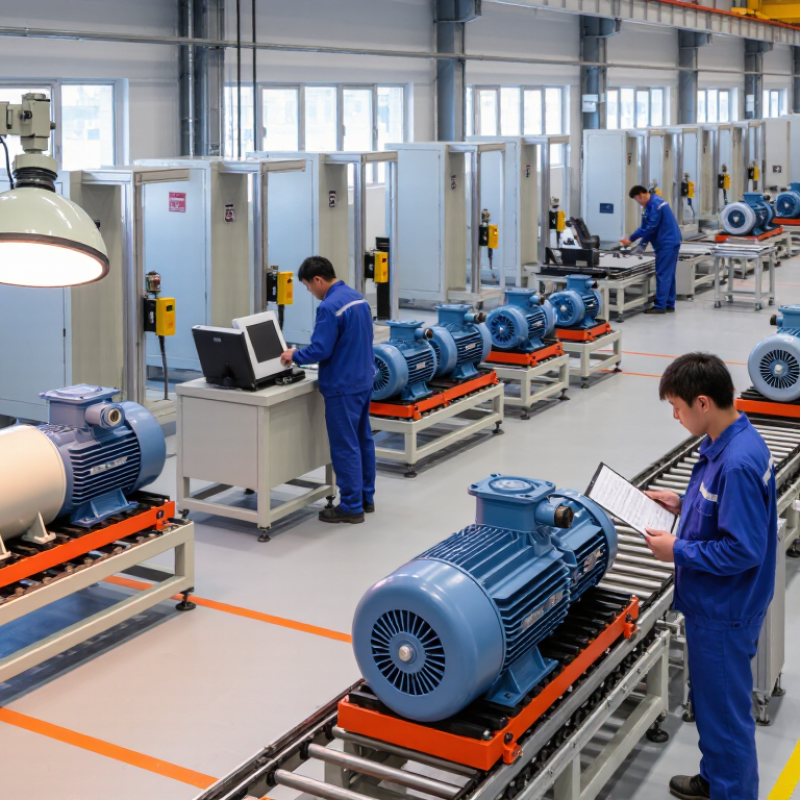
Visit the factory remotely or in person when possible. Observe winding, rotor balancing, insulation testing, and final-load inspection. Ask how rejected parts are isolated and how corrective actions are documented. Production capacity matters, but stable process control matters more. Check whether sample motors use the same materials and assembly steps as volume orders. This detail is often overlooked. It should not be.
Assess communication through a technical trial. Send one operating scenario and request a suitable motor, belt ratio, protection level, and maintenance schedule. Compare technical accuracy, not only response speed. Confirm spare-part availability, warranty boundaries, delivery records, and export documentation. Independent testing can verify noise, vibration, efficiency, and temperature rise. Be cautious with unusually low quotations; they may exclude testing or use weaker bearings. Still, no evaluation is perfect. Your assumptions may be wrong, especially when seasonal heat or dust changes the load. Recheck the design after pilot operation.
Belt drive motors serve industries where steady power, flexible speed control, and shock absorption matter. Manufacturing plants use them on conveyors, packaging lines, fans, pumps, and machine tools. The belt can separate the motor from dust, vibration, or heat. This arrangement also allows technicians to change pulley sizes when production requirements shift.
Agriculture depends on belt drive systems for grain handling, ventilation fans, feed mixers, and irrigation equipment. A belt can tolerate brief overloads during startup, which helps when machinery handles heavy crops. However, moisture and loose material can cause slipping. Operators should inspect tension, pulley alignment, and belt wear during routine service. Small cracks often become expensive failures.
Warehouses and distribution centers use these motors in roller conveyors and sorting equipment. Their smooth engagement reduces sudden movement around cartons and workers. Construction materials, recycling facilities, and mining operations also use them for crushers, screens, and material conveyors. These environments demand guarded moving parts and suitable protection against dust. I have seen teams focus on motor power while overlooking belt temperature and alignment. That mistake is easy to repeat. Quiet operation does not always mean proper tension. Engineers should check the load profile, duty cycle, ambient conditions, and maintenance access before selecting a system.
| Industry | Typical Equipment | Why Belt Drive Motors Are Used | Typical Operating Duty | Common Motor Power Range | Important Selection Requirements | Recommended Manufacturer Evaluation Criteria |
|---|---|---|---|---|---|---|
| HVAC and Ventilation | Air-handling units, exhaust fans, supply-air fans, rooftop ventilation systems | Provides flexible speed adjustment, absorbs vibration, and allows the motor to be positioned away from the airflow. | Continuous duty8–24 hours/day | 0.37–45 kW | Low noise, corrosion resistance, reliable bearings, suitable pulley ratio, and efficient cooling. | Verified efficiency data, dynamic balancing capability, insulation class, enclosure protection, and spare-parts availability. |
| Material Handling | Belt conveyors, roller conveyors, package sorting lines, bulk-material transfer systems | Delivers dependable torque transmission and permits convenient motor placement for maintenance access. | Intermittent or continuousFrequent starts | 0.75–75 kW | Starting torque, overload capacity, pulley alignment, belt tension control, and braking requirements. | Load-test capability, acceleration performance, shaft and bearing strength, dimensional consistency, and customization support. |
| Agriculture | Grain augers, feed mixers, irrigation pumps, ventilation fans, threshing and harvesting equipment | Offers simple mechanical power transmission and can tolerate changing operating conditions when properly protected. | SeasonalDusty environments | 0.75–55 kW | Dust protection, moisture resistance, high starting torque, easy belt replacement, and stable operation under variable loads. | Ingress-protection rating, environmental testing, overload protection, serviceability, and availability of standard mounting dimensions. |
| Industrial Manufacturing | Machine tools, mixers, grinders, pumps, fans, compressors, and production-line auxiliary equipment | Supports speed conversion, reduces shock transmission, and provides a relatively simple alternative to more complex drives. | Continuous dutyHigh utilization | 1.1–110 kW | Stable speed, vibration control, thermal performance, duty-cycle compatibility, and precise shaft dimensions. | Quality-management processes, production repeatability, test documentation, efficiency class, and technical engineering support. |
| Mining and Quarrying | Crushers, screens, conveyors, feeders, ventilation systems, and dewatering equipment | Provides robust power transmission and helps isolate the motor from certain mechanical impacts and vibration. | Heavy duty24-hour operation | 7.5–315 kW | High overload capability, reinforced bearings, dust resistance, thermal protection, and reliable belt alignment. | Documented endurance testing, mechanical-strength verification, enclosure protection, maintenance support, and site-condition adaptability. |
| Food and Beverage Processing | Conveyors, mixers, pumps, blowers, filling lines, and packaging machinery | Allows flexible equipment layout and can simplify replacement when hygienic guarding and proper sealing are provided. | Continuous dutyWashdown areas | 0.25–45 kW | Washdown resistance, smooth surfaces, low vibration, food-area compatibility, and protection against moisture ingress. | Hygienic construction options, corrosion-resistant materials, cleanability, test certificates, and compliance documentation. |
| Water and Wastewater | Aeration blowers, ventilation fans, sludge-handling equipment, pumps, and screening systems | Enables flexible speed ratios and reliable operation in equipment rooms where motor access and ventilation are important. | Continuous dutyHigh annual runtime | 1.1–250 kW | Moisture and corrosion protection, energy efficiency, low maintenance, thermal stability, and compatible control systems. | Efficiency verification, insulation quality, corrosion-resistant options, lifecycle support, and compatibility with variable-frequency drives. |
| Construction Equipment | Concrete mixers, portable crushers, screening machines, compressors, and site ventilation equipment | Provides a practical and serviceable transmission solution for mobile or semi-mobile machinery. | Variable dutyHigh shock loads | 1.5–160 kW | Compact design, impact resistance, strong starting performance, mechanical protection, and accessible maintenance points. | Vibration and shock testing, mounting flexibility, transport durability, field-service support, and replacement-part availability. |
| Commercial Laundry | Industrial washers, tumble dryers, extractors, ventilation fans, and material conveyors | Supports speed adjustment and can separate the motor from heat, moisture, and rotating process equipment. | Repeated cyclesHigh humidity | 0.75–45 kW | Moisture resistance, reliable belt tension, low noise, thermal protection, and compatibility with frequent reversing or braking. | Cycle-life testing, bearing quality, thermal performance, control compatibility, and straightforward maintenance procedures. |
| Renewable Energy and Utility Systems | Cooling fans, ventilation units, auxiliary pumps, biomass handling systems, and small hydro-mechanical auxiliaries | Offers flexible mechanical layout and allows speed matching between the motor and driven equipment. | Continuous dutyOutdoor or remote sites | 0.75–200 kW | High efficiency, environmental sealing, remote monitoring compatibility, low maintenance, and long service life. | Efficiency and reliability records, environmental qualification, documentation quality, customization capability, and long-term technical support. |
Selecting the best belt drive motor manufacturer begins with your application, not a product catalogue. A belt drive motor can face dust, heat, vibration, frequent starts, or continuous operation. The wrong supplier may offer a motor that fits physically but fails under real working conditions. Start with the application. Record required power, torque, speed, duty cycle, voltage, mounting space, and ambient temperature. A manufacturer that asks detailed questions usually understands engineering risks. That question matters.
Check the manufacturer’s production experience and quality controls. Ask whether motor winding, insulation, balancing, and load testing occur in-house. Request test records, inspection standards, and traceable documentation for each batch. Reliable suppliers should explain their tolerance limits clearly. They should also provide drawings, performance curves, installation guidance, and maintenance recommendations. Vague answers are a warning sign. I have seen low quotations become expensive after repeated belt failures and delayed replacements.
Before placing a large order, evaluate a sample under realistic conditions. Measure temperature rise, noise, vibration, starting performance, and energy use. Test the motor with your actual pulley and belt arrangement when possible. Review the supplier’s response time, spare-part support, packaging, and delivery consistency. Certifications can help, but they do not replace application testing. A polished factory video proves little. Factory audits, video inspections, or independent testing may reveal more. Leave room for doubt; even a promising sample may not represent every production batch.
It transfers rotational power through a motor pulley, belt, and driven pulley. The belt carries motion between shafts.
Different pulley sizes can change speed, torque, and shaft direction without complex gearing. Simple, but not friction-free.
A loose belt slips, creates heat, and lowers output. An overly tight belt strains bearings. Correct tension needs regular checking.
Even a small offset may cause edge wear, vibration, and irritating noise. Watch the belt path during inspection.
Check torque, speed range, duty cycle, pulley diameter, temperature, load changes, and maintenance conditions. Dust can change the answer.
Common applications include conveyors, fans, pumps, agricultural machines, and workshop equipment. Each load needs separate testing.
Request drawings, tolerance tables, wiring diagrams, test records, protection levels, and replacement-belt information. Specific answers matter more than polished catalogs.
Review winding, rotor balancing, insulation testing, and final-load inspection. Confirm samples use the same materials as volume orders.
Independent testing can measure noise, vibration, efficiency, and temperature rise. Published figures may differ from field results.
Inspect cracks, dust buildup, belt tension, alignment, and unusual vibration during scheduled checks. Guard exposed rotating parts. Small oversights matter.
This guide explains what a Belt Drive Motor is, how it transfers power through pulleys and belts, and why this design is valued for smooth operation, flexible speed control, reduced vibration, and easier maintenance. It also examines why Chinese manufacturers are widely considered for these motors, including their production capacity, engineering expertise, customization options, and competitive pricing. Buyers will learn how to compare leading suppliers by reviewing product quality, motor efficiency, belt compatibility, testing procedures, certifications, delivery capability, and after-sales support.
The article also introduces the industries that commonly use belt drive systems, such as ventilation, industrial machinery, agriculture, material handling, and automated equipment. Finally, it provides practical guidance for selecting the most suitable manufacturer based on application requirements, operating environment, load, speed, noise level, installation space, and long-term service expectations. By following these criteria, purchasers can make a more informed decision and choose a reliable Belt Drive Motor solution that balances performance, durability, safety, and overall value.
